
FOR LETTING AGENTS
What London Letting Agents Should Expect from a Professional Property Inventory Report
A professional property inventory report should give a letting agent a clear, structured record that is easy to review, easy to retain on the property file and useful throughout the tenancy. Here we explain the reporting standards, evidence and practical details that agents should expect from a professional inventory provider.
WHAT GOOD REPORTING SHOULD DELIVER
A report that works for the property file
For a letting agent, a professional inventory report needs to do more than simply list what is present at the property. It should provide a clear, structured record that can be referred to throughout the tenancy and reviewed efficiently when the property is checked out.
A well-prepared report should be easy to navigate, use consistent descriptions and present the recorded information in a way that makes later comparison straightforward.
For an Inventory & Check-In, this should include a room-by-room record of the contents, fixtures and fittings together with the condition and cleanliness recorded at the start of the tenancy. Supporting photographs, relevant meter readings and key information should also be recorded where applicable.
At Dock Inventories, reports are also internally reviewed before delivery to help maintain consistent reporting standards and reduce avoidable corrections or follow-up.
INSIDE THE REPORT
What should a letting agent expect to see?
Clear room-by-room reporting
The report should follow the property logically, with rooms and areas clearly identified. Contents, fixtures and fittings should be described consistently so that the record can be reviewed easily later in the tenancy.
Condition and cleanliness where applicable
Where a Check-In forms part of the instruction, the visible condition and cleanliness of the property should be recorded at the start of the tenancy. This creates a clear opening record for later comparison.
Supporting photographs
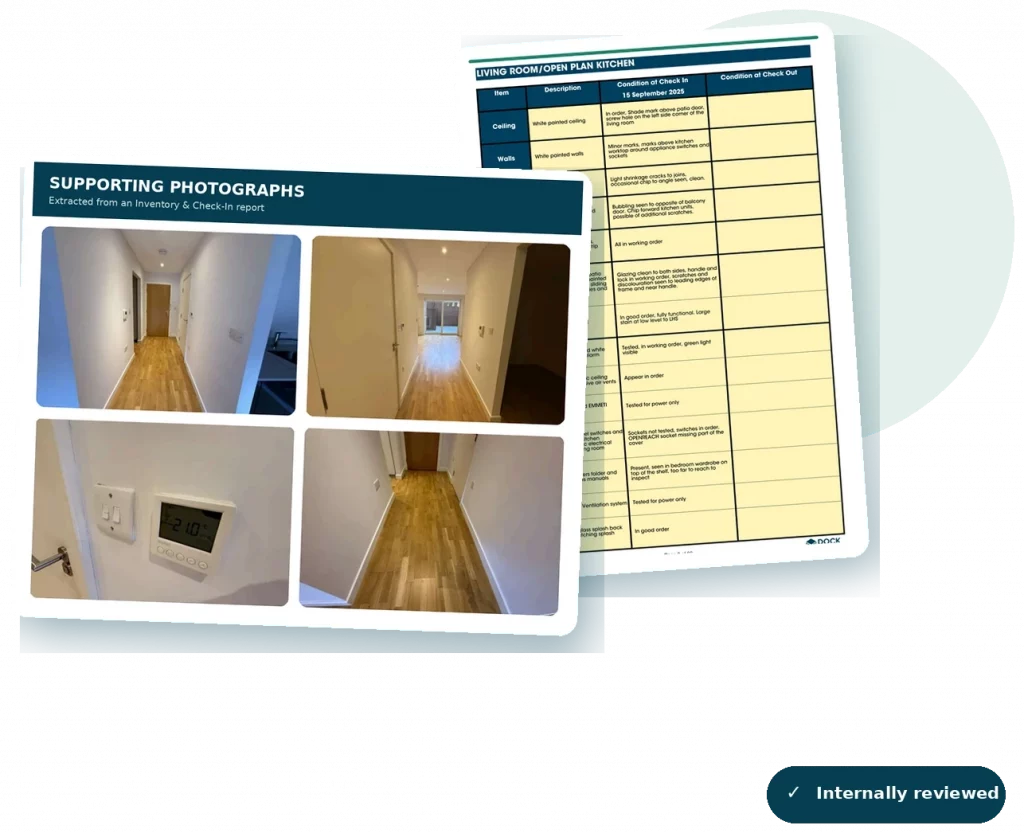
Photographs should support the written record rather than replace it. They should help identify the property, items and observations being described and provide useful visual evidence alongside the report.
Meter readings and alarms
Accessible meter readings should be recorded where available. Relevant smoke and carbon monoxide alarm information can also be noted at the time of the inspection where applicable.
Keys and handover information
Where keys form part of the Check-In process, the report should provide a clear record of the keys presented or handed over at the appointment.
Consistent presentation
A professional report should be easy for a property manager to navigate quickly. Consistent terminology, organised photographs and a clear structure make the report more useful when it needs to be referred to months later.
QUALITY CONTROL
Why consistency matters to a letting agent
When an agency is managing multiple properties, consistency between reports becomes particularly important. A report should be structured in a familiar way so that property managers can find the information they need without having to interpret a different reporting style on every instruction.
Consistent descriptions and presentation also make later comparison easier. At Check-Out, the usefulness of the opening record depends not only on the amount of information recorded, but on how clearly that information can be identified and compared.
Dock Inventories operates an internal review process before reports are delivered. This additional check is intended to support consistent reporting standards, identify avoidable errors and reduce unnecessary follow-up for the instructing agent.
Internally reviewed before delivery
An additional quality-control stage designed to support clear and consistent reporting.
PHOTOGRAPHIC EVIDENCE
Photographs should support the written record
Photographs are an important part of a professional property inventory report, but they should support the written record rather than replace it. A photograph may show what was visible at the time of inspection, while the accompanying description provides the context needed to understand what is being recorded.
For letting agents, this becomes particularly useful when a report needs to be reviewed later in the tenancy. Clear photographs combined with specific written observations make it easier to identify the relevant item, area or issue without relying on images alone.
The strongest reports use photographs selectively and purposefully, linking them to the room-by-room record rather than simply adding large numbers of images without explanation.
CHOOSING AN INVENTORY PROVIDER
A clear opening record makes Check-Out more useful
A professional Inventory & Check-In report is not only a record of the property at the start of the tenancy. Its value becomes particularly clear when the property is later inspected at Check-Out and the opening information can be used as the basis for comparison.
Where a suitable starting report is available, the Check-Out can identify relevant changes in condition, cleanliness, contents and presentation. Clear descriptions and well-organised photographs make it easier for the letting agent to understand what has changed since the tenancy began.
The quality of that comparison depends heavily on the quality of the original record. Vague descriptions, missing photographs or inconsistent room references can make later assessment unnecessarily difficult.
Dock may record an observational or professional opinion where appropriate, including comments on fair wear and tear, apparent responsibility or possible liability. Final decisions on legal liability, deposit deductions and the outcome of any dispute remain with the relevant parties or, where applicable, the tenancy deposit scheme or adjudicator.
PRACTICAL DETAILS
The details that help at the start of a tenancy
A professional Inventory & Check-In report should also capture the practical information available at the appointment, not only the visible condition of the property.
Where accessible and available, this may include meter readings, key schedules and relevant smoke and carbon monoxide alarm information. Recording these details at the start of the tenancy gives the letting agent a clearer reference point and can reduce avoidable queries after the tenant has moved in.
For agency teams handling a high volume of instructions, having these details presented consistently within the report also makes the handover process easier to manage and the property file more complete.
Dock Inventories records available meter readings and key information as part of the instructed service where applicable, alongside the wider property record.
CHOOSING AN INVENTORY PROVIDER
What should a letting agent look for?
A property inventory provider becomes part of an agency’s tenancy process, so the quality of the service should extend beyond simply attending the property and producing a report.
Letting agents should look for clear reporting standards, reliable appointment management, consistent presentation and a reporting process that makes information easy for property managers to review and retain.
It is also worth considering how reports are checked before delivery, how queries or amendments are handled and whether the provider can maintain the same standard across a portfolio of properties and different inspection types.
For agencies managing properties across London, a dependable inventory partner should ultimately make the process easier: providing clear evidence, reliable appointments and reports that can be referred to confidently throughout the tenancy.
A professional provider should offer:
✓ Clear and structured reports
✓ Consistent room-by-room reporting
✓ Supporting photographic evidence
✓ Reliable appointment management
✓ Practical details recorded where applicable
✓ Quality control before report delivery
PROPERTY REPORTING ACROSS LONDON
Need a reliable inventory partner for your agency?
Dock Inventories provides Inventory & Check-In, Check-Out, Mid-Term and other property reporting services for letting agents, property managers and landlords across Greater London.
If you manage regular property instructions, learn more about our property inventory services for letting agents and property managers.